Saving is not organizing
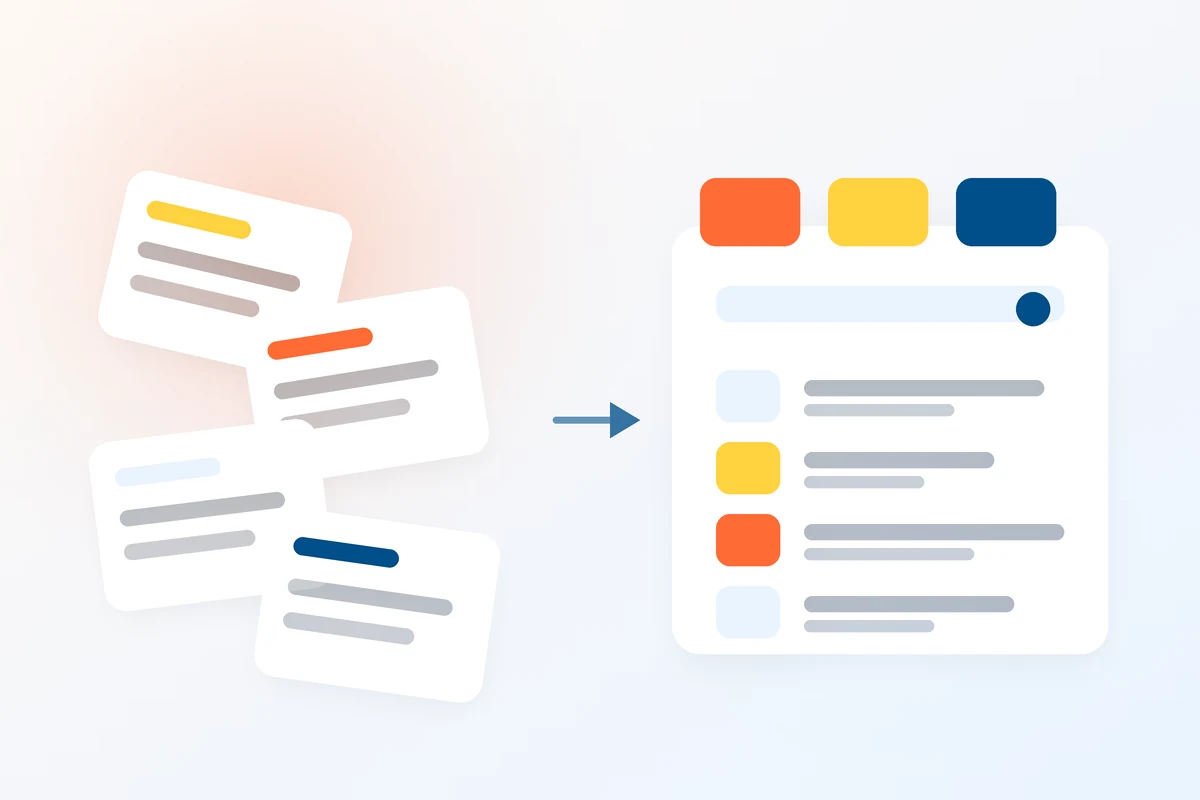
Most people do not have a recipe problem. They have hundreds of recipes — in browser bookmarks, in a screenshots folder, in messages they sent themselves, in three different apps, in a cookbook with a page corner turned down, and on a card in a parent's handwriting.
What they do not have is a way to find the right one at 18:00 on a Tuesday. So they cook the same six things and save more recipes they will never open. Saving feels like progress; it is closer to hoarding.
A recipe system is not a filing cabinet. It is a retrieval tool, and it only has to answer two questions.
The two questions your system must answer
"What should I cook tonight?" and "Where is that thing I made in March?"
Everything else is decoration. If your system answers those two reliably, it is a good system regardless of what it looks like. If it does not, no amount of tagging will save it.
The two questions need different things. The first needs browsing by situation — you do not know what you want, and you need a short list of plausible options. The second needs search by memory fragment — you know exactly what you want and remember one detail about it.
Most people build for the second question and wonder why the system does not help on a weeknight.
Organize by occasion, not by cuisine
This is the single change that makes the biggest difference, and it is counterintuitive because every cookbook and every recipe site is organized the other way.
Cuisine categories fail on a weeknight because you do not stand in the kitchen thinking "I would like Italian." You think "I have twenty-five minutes and there is chicken in the fridge." A system sorted by cuisine cannot answer that. A system sorted by situation can.
Occasion categories that work for most households:
- Fast weeknight — under 30 minutes, minimal attention.
- Uses up vegetables — the flexible dishes that absorb whatever is going soft.
- Cook once, eat twice — things that reheat or repurpose well.
- Weekend cooking — the ones that are the activity, not the obligation.
- Feeds guests — scales up and can be made partly in advance.
- Nobody complains — the small, unglamorous list that everyone in the house will eat.
Six to eight categories is the right number. If you have twenty, you are back to searching, and you will not maintain them.
Keep cuisine and ingredient as secondary labels for the second question. They are useful for finding something specific; they are useless for deciding.
Record whether you actually cooked it
Almost no recipe system captures the most valuable piece of information: did you make it, and was it good?
A saved recipe you have never cooked is a hypothesis. A recipe you made twice and adjusted is an asset. If your system cannot tell the difference, its top results will always be dominated by things you have never tried.
Mark the ones you have cooked. Rate them roughly — three levels is plenty: make again, fine, no. Then, when you browse for a weeknight, filter to the ones already proven. Your best twenty recipes are worth more than your other four hundred combined, and after a month of marking you will know what they are.
Add one line of notes each time you cook something: what you changed, what to do differently, how many it actually fed. Those notes are the part that cannot be replaced by re-searching the internet.
Deal with the screenshots and the links
Two categories quietly break every system, and both need a decision rather than a folder.
Screenshots are unsearchable. A folder of four hundred food photos is a folder you will never open. Either type the recipe out properly when you save it, or accept that the screenshot is a fleeting bookmark rather than something you own. There is no third option where the screenshot folder becomes useful later.
Links rot. Sites close, redesign, add paywalls, and rewrite recipes. Anything you actually cook should be saved as text you control, not as a URL you hope still works. Copy the ingredients and method into your own recipe, credit the source, and add the link as a reference rather than as the recipe itself.
The general principle: if you would be annoyed to lose it, it needs to exist as text in a place you control.
One place, not six
The reason most systems fail is not the structure. It is that recipes live in six places, so none of them is complete, so you check the internet instead, so nothing gets better.
Consolidating is boring and it is the highest-value hour you will spend on this. It does not require moving everything: move the ones you have actually cooked, plus the ones you genuinely intend to cook this month. The rest can stay where it is, and you will not miss it.
Whatever you consolidate into should be available where you cook. A system that only exists on a laptop is not available in a kitchen, which is why keeping recipes in one account across phone, tablet, and web matters more than any feature. CookFeed is built around that: recipes you save, generate, or adapt stay in one place, can be organized into collections, and are available in a step-by-step cook mode with timers when you are actually at the stove.
Prune once a year
A recipe collection has a natural size, and for most households it is far smaller than the collection they have.
Once a year, delete anything you saved more than a year ago and never cooked. You did not want it; you wanted the feeling of intending to want it. Nothing is lost — if you genuinely need it again, it is one search away.
What remains is a collection where the top of the list is food you like, that you know works, that fits your actual week. At that point the system starts answering the first question — what should I cook tonight — which is the whole reason to have one. Our guide on deciding what to cook tonight covers what to do with those ten minutes once your collection is worth browsing.